
A2 Fire-Rated Aluminium Composite Panel: A Sourcing Guide
A2 is the grade most facade codes are written around, and it is the grade buyers most often get wrong — usually because a supplier sells “fireproof” panels that are not A2 at all. This guide explains what A2 actually means, which standard applies to your market, and the specifications worth putting in writing before you place an order.
What “A2” actually means
Fire performance is not a yes-or-no property. It is a position on a classification scale. In Europe, EN 13501-1 ranks reaction to fire from A1 (non-combustible) through A2 (limited combustibility), then B, C, D, E and F. A2 is the second-highest class a composite panel can realistically reach.
The decisive difference is the core. A standard ACP uses a polyethylene (PE) core. Panels sold as “FR” or “B1” use a flame-retardant PE core — they resist ignition, but the core is still a combustible polymer. An A2 panel replaces that core with a mineral filler, so the panel contributes very little fuel to a fire in the first place — the basis on which an A2-s1,d0 fire-rated composite panel is classified. That is why A2 is normally the grade specified for high-rise and public-building facades.
Three standards, one idea
Different markets express the same requirement on different scales. Know which one your project is written against before you request documents. For EN 13501-1 projects, the s1 and d0 sub-classes decide whether an A2 panel is accepted — that guide explains how they are read.
- Europe and most export markets — EN 13501-1. Look for A2-s1,d0: A2 for limited combustibility, s1 for the lowest smoke production, and d0 for no flaming droplets.
- China — GB 8624, where the equivalent grade is simply A2.
- United States — ASTM E84 for surface burning characteristics, and for exterior wall assemblies, NFPA 285. NFPA 285 is an assembly test rather than a product test: it depends on how the whole wall is built, not on the panel alone. For the documentation a US project needs, see US project documentation and NOA.
These classification documents are not interchangeable. A supplier who only offers one certificate may simply be quoting the market they sell to most, so ask for the report that matches your destination.
What to specify
Write these into the enquiry. Vague enquiries get vague quotes, and “fireproof” is not a specification.
- Reaction-to-fire class — A2-s1,d0 (EN 13501-1) or A2 (GB 8624).
- Panel thickness — 4 mm is standard for facades; 3 mm, 5 mm and 6 mm are available for other applications.
- Aluminium skin thickness — 0.5 mm is common; state it explicitly, because the total panel thickness does not tell you the skin.
- Coating — PVDF (fluorocarbon) for exterior facades, polyester for interior and signage work.
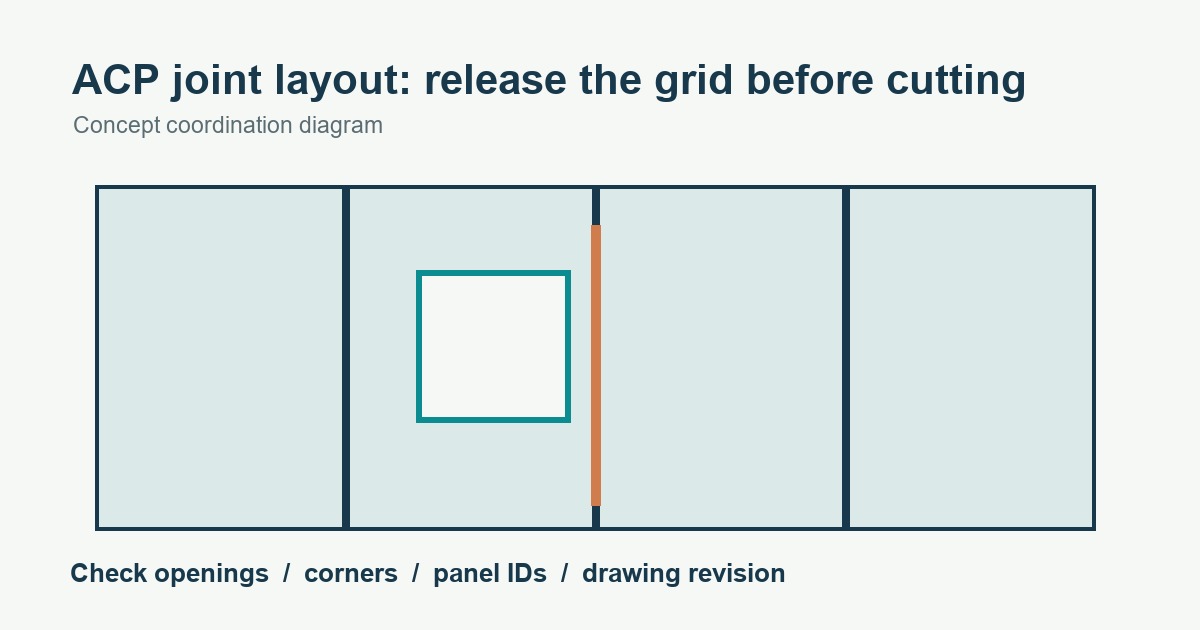
- Sheet size — 1220 × 2440 mm is standard; wider sheets reduce the number of vertical joints.
- Colour and finish — solid, metallic, wood, mirror or brushed.
Six questions to ask any supplier
- Is the fire test report for this panel, or only for the mineral core you buy in?
- Do you run your own A2 composite line, or do you buy A2 panels and resell them?
- Where do the aluminium coil and the coating come from?
- What is your MOQ for a stock colour, and for a custom colour?
- What is the lead time after deposit, in writing?
- Can you send a sample in the exact thickness and colour before we commit to a container?
A trader can answer the first question and few of the rest. A factory can answer all six, and will usually offer a factory video or a remote tour without being pushed.
Documents you can verify before you pay
A fire-rated order is only as good as the paperwork behind it. These are the documents worth collecting before a deposit, and how to check each one:
- ISO 9001 certificate — check the certificate number and validity date, then confirm it with the certification body. JINXIANG has held ISO 9001 certification since 2002, currently to ISO 9001:2015 (certificate USA24Q41233R4M). The fire test report numbers are listed on test reports and certificates.
- The fire test report for the panel you are buying — not for the mineral core alone, and not for a different skin thickness. The report should name the product family it covers.
- The standard your market actually uses — EN 13501-1 (A2-s1,d0) for Europe and much of the Middle East, ASTM E84 and NFPA 285 for the United States. NFPA 285 is an assembly test: it covers the whole wall build-up, so ask for the assembly it was tested in.
- The report number and its field of application — our panels are classified to EN 13501-1:2018 by SGS: AJFS2310010059FF gives A2-s1,d0 for the A2 panel, AJFS2310009865FF gives B-s1,d0 for the B1 panel; both carry the CNAS and ILAC-MRA marks. Read the field of application on page 4: the classification holds for A1/A2 substrates, mechanically fixed, with no joint — so match it to your build-up before you rely on it.
- Company-side evidence — business licence details matching the factory address, and the tax-standing record. JINXIANG has been on the Jinhua A-class taxpayer list every year since 2016, and holds patent CN 222554454 U for panel structure.
None of this is exotic. It is simply the difference between a supplier who can produce the file in an hour and one who has to ask someone else for it.
About Jinxiang
Zhejiang Jinxiang Panel Industry Co., Ltd. manufactures A2 fire-rated aluminium composite panel on a dedicated 1.6-metre-wide A2 line — wider than the 1220 mm and 1250 mm sheets most suppliers ship, which lets you reduce the number of vertical joints across a facade. Panels are produced at our factory in Jinhua, Zhejiang, where we also run in-house coil coating lines and continuous multi-coat/bake coil lines, so the coil, the coating and the composite panel stay under one roof. We have manufactured aluminium composite panel since 2000 and export to Europe, the Middle East, Africa and Asia. MOQ is one standard container for stock colours, with a 500 sqm minimum per colour for custom colours, and lead time is 10–15 days after deposit.
Tell us your destination market and we will send the fire test documentation that applies to it. See the A2 fireproof aluminium composite panel range, compare it with our full aluminium composite panel range, see how A2 ACP compares with solid aluminium and honeycomb panels, or contact us for a sample kit, a test report, or a factory tour — remote or in person.